astro-lab.app
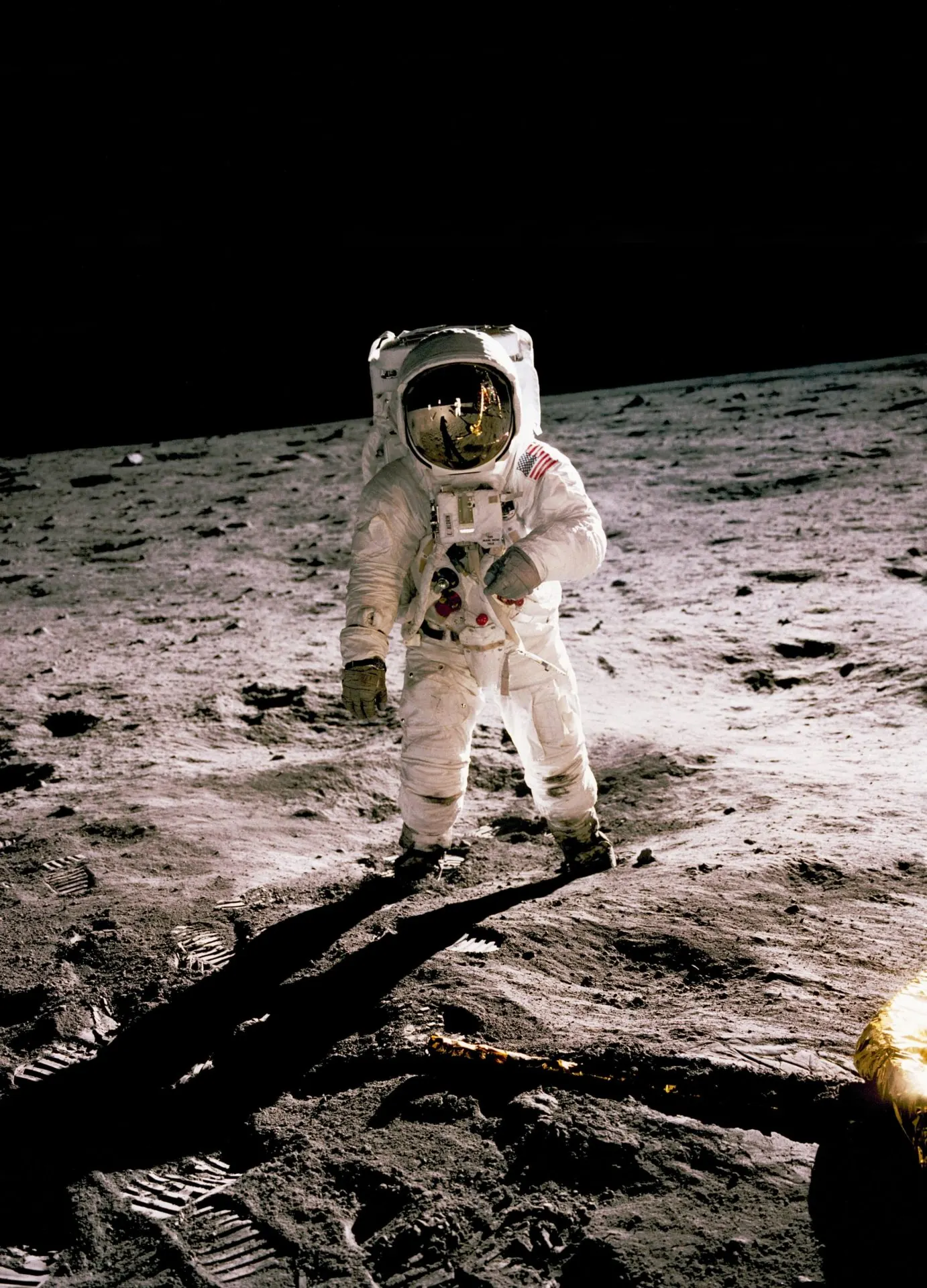
Astronaut on the moon

Open Educational Resources

astro-lab.app

Smartphone experiments and teaching materials for astronomy and space physics.

12

Experiments

27

Publications

CC BY

Open Licence

What’s here

Experiments, materials, resources

01

Smartphone Experiments

Most experiments use sensors already in your phone — light meter, accelerometer, gyroscope, camera. Some setups add external hardware via Bluetooth. Instructions are in German and English.

02

Open Educational Resources

Every worksheet, dataset, and guide is released under an open license. Download, adapt, and use in class without registration or restrictions.

03

Videos

Each experiment links to a short video showing the setup and what to expect. Useful before the first run, or when something isn't behaving as expected.

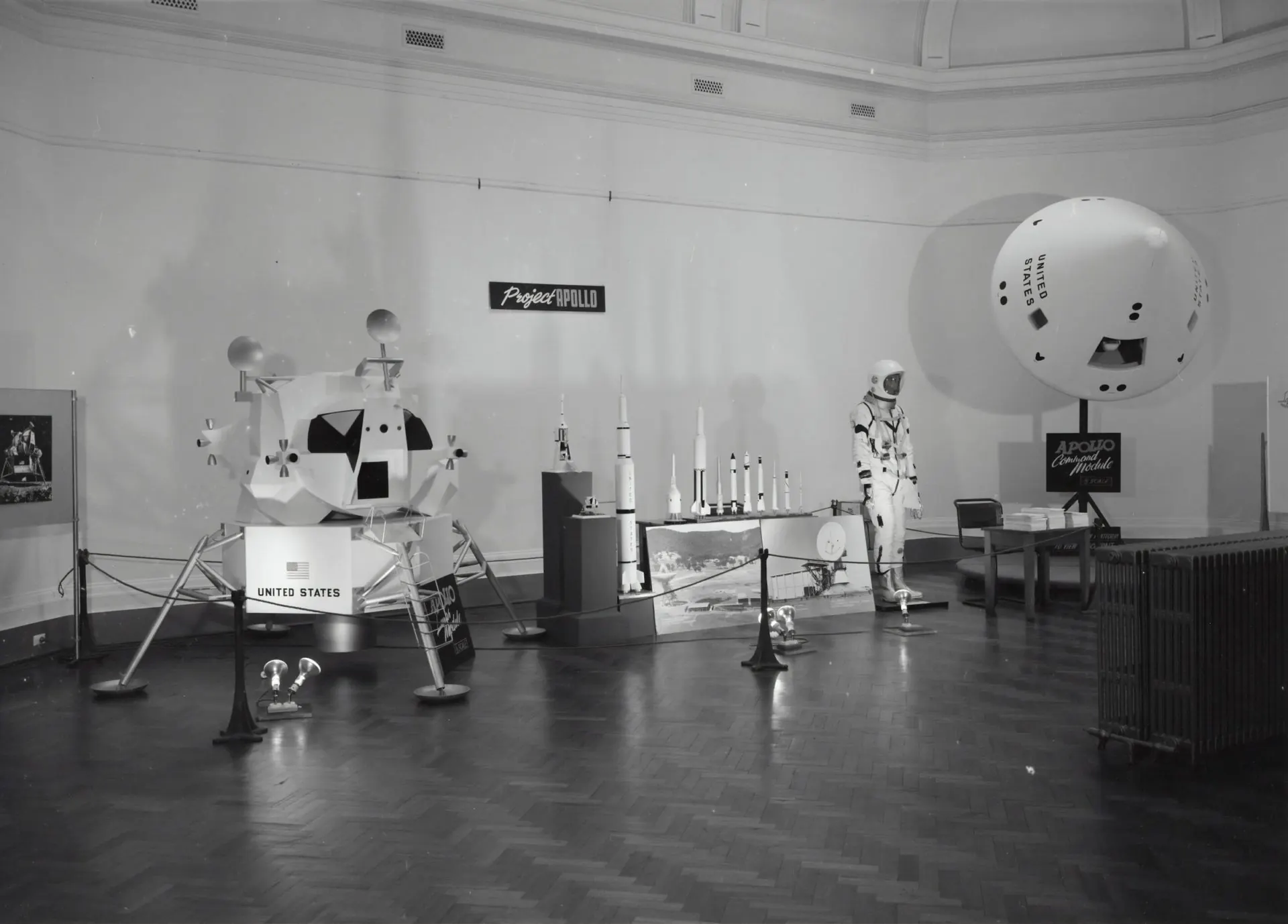
Black-and-white photo of an Apollo exhibition with a lunar module model and a spacesuit

Astronomy · Physics · Education

Measure before you theorise

A smartphone contains an accelerometer, a barometer, a light sensor, and a camera. These experiments treat them as instruments — each with a defined procedure, a dataset to record, and a direct connection to something observable in the sky.

Open Educational Resources

Experiments

Interactive simulation

EN

Exoplanet and binary-star labs in a browser tab

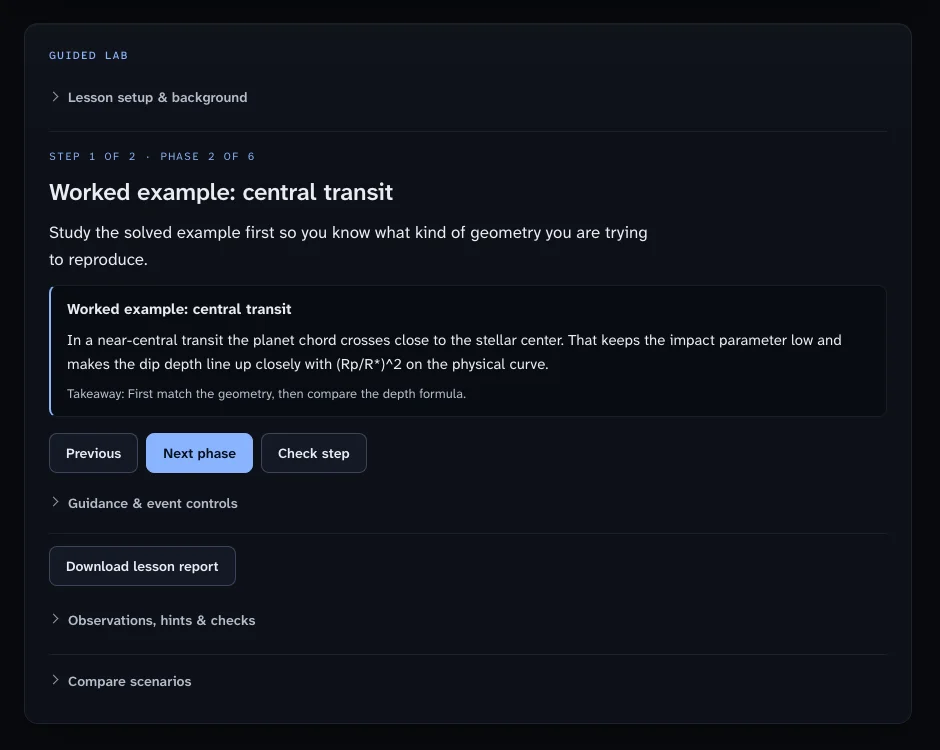
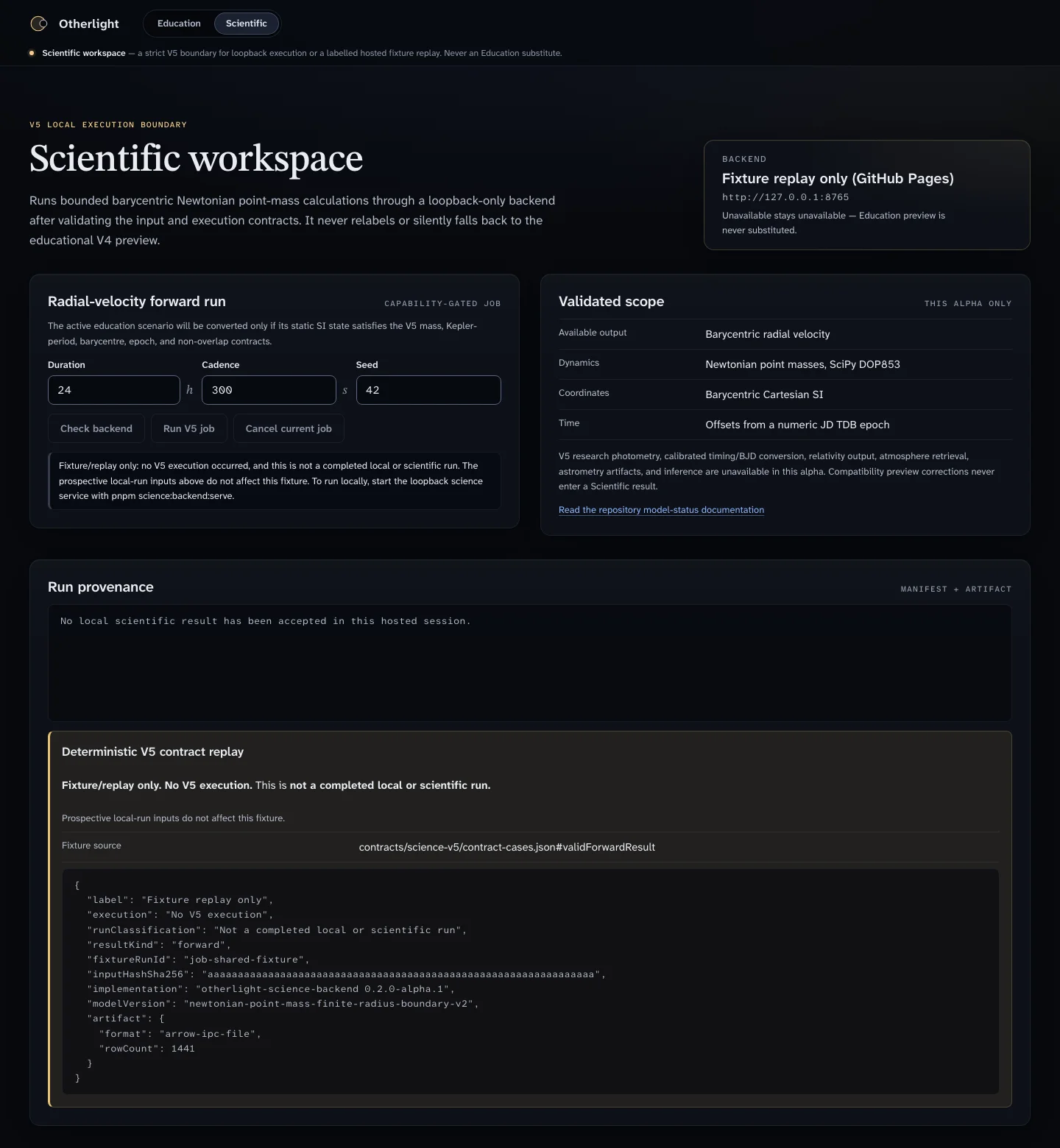
Exoplanet transits, exomoons and binary stars as interactive labs in the browser: change a planet's size or orbit and watch the light curve respond, follow a Guided Lab from hypothesis to interpretation, or run a validated radial-velocity model on your own machine.

  • Simulation. Change a planet's radius, orbit or moon and watch the light curve answer back.
  • Guided Labs. Hypothesis, experiment and interpretation, step by step, with a downloadable lesson report.
  • Scientific. A validated radial-velocity model that runs on your own machine.
simulationbrowser apptransitlight curvesexomoonsbinary stars

Runs in the browser, no account or upload. Source on GitHub · MIT licence
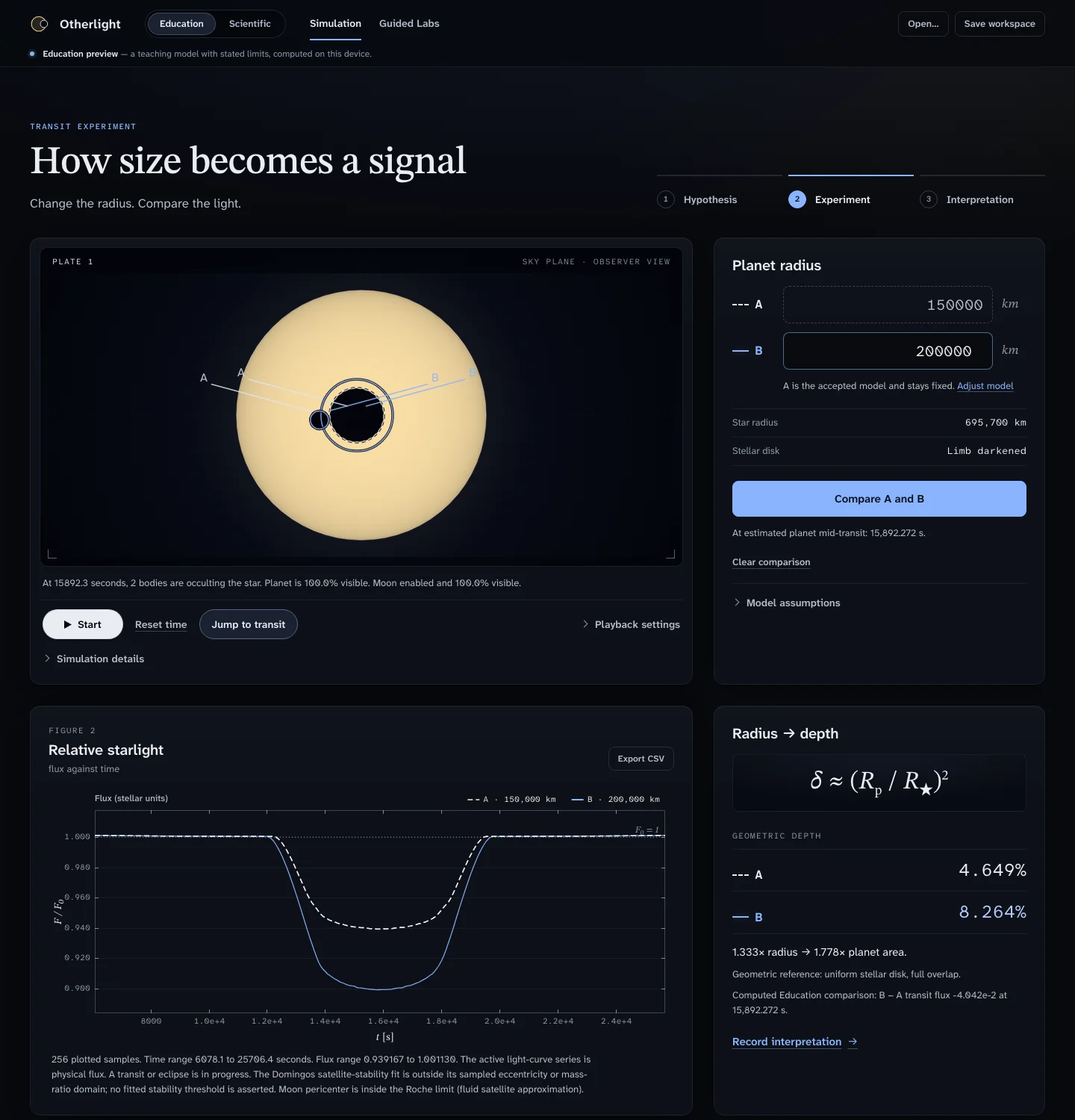
Otherlight Education workspace: the star seen from the observer with two planet sizes, A and B, the relative-starlight curve with two transit dips, and the transit depth formula.
Guided Lab: a worked example for a central transit, with phase navigation and the lesson report download.
Scientific workspace: the radial-velocity run form, the validated scope and the run provenance.
Screenshots of the live app: simulation, Guided Lab and Scientific workspace. Screenshot tour
Quick filter:···

Mission to Mars — Spacecraft Prototyping

EN/DE

Build a spacecraft prototype from everyday materials, seal a pressure sensor inside, and test it under a vacuum bell jar — measuring whether your crew would survive.

pressure sensorphyphoxengineeringair pressuredesign challenge
View details →

Star Formation: Pressure and Temperature

EN/DE

Compress a gas-filled syringe with an external pressure and temperature sensor inside — and watch phyphox record the simultaneous rise in both quantities, an analogy for collapsing stellar nebulae.

pressure sensorphyphoxstellar physicsthermodynamicsstar formation
View details →

Transit Method

EN/DE

Simulate exoplanet detection by moving a Styrofoam ball around a lamp and recording a real-time light curve with phyphox.

light sensorphyphoxexoplanetslight curvestransit
View details →

References

Publications

Quick filter:···
  1. 2024

    The Physics Teacher

    Exoplanet Hunting in the Classroom: An Easy-to-Implement Experiment Based on Video-Aided Light Curve Analysis with Smartphones

    S. J. Spicker & A. Küpper

    ↗
  2. 2022

    Astronomie + Raumfahrt im Unterricht

    Analogy Experiments on the Transit Method for Physics and Astronomy Education at Lower Secondary Level

    A. Küpper, S. J. Spicker & A. Schadschneider

    ↗
  3. 2022

    Communicating Astronomy with the Public Journal (CAPjournal)

    astro-lab@home — Bringing Science to the Sofa

    S. J. Spicker, A. Küpper & A. Bresges

    ↗
  4. 2022

    Astronomie + Raumfahrt im Unterricht

    astro-lab@school — A Student Laboratory 2.0 for Physics and Astronomy Education

    S. J. Spicker & A. Küpper

    ↗
  5. 2022

    The Physics Teacher

    Mission to Mars — A Design-Based Hands-On Smartphone Experiment on Air Pressure

    S. J. Spicker, A. Küpper & A. Bresges

    ↗
  6. 2021

    Jahrestagung der Astronomischen Gesellschaft 2021, Splinter 'Bildung'

    astro-lab@home

    A. Küpper & S. J. Spicker

    ↗

Collaboration

Partners

phyphox logo — RWTH Aachen University

phyphox

RWTH Aachen University

phyphox turns a smartphone into a data logger. The app reads from built-in sensors — accelerometer, barometer, light, microphone — and from external Bluetooth hardware. Most experiments on this site use phyphox for measurement and data export.

Institute of Physics Education logo — University of Cologne

Institute of Physics Education

University of Cologne

The Institute of Physics Education at the University of Cologne supports the development of the teaching materials and co-authors the academic publications that accompany this project.

Physics Reimagined logo — University Paris-Saclay

Physics Reimagined

University Paris-Saclay

Physics Reimagined develops teaching sequences and visualization tools for modern physics — including superconductivity, quantum optics, and cosmology — at Paris-Saclay.

LekkerWissen logo — Science Communication

LekkerWissen

Science Communication

LekkerWissen produces short science explanation videos for YouTube. Several videos are linked directly from experiment pages to show setup and expected results.

Who we are

Team

The project is maintained by two physicists from Cologne.

Sebastian J. Spicker — Physicist, Developer

Sebastian J. Spicker

Physicist, Developer

Physics graduate, University of Cologne. Researcher at the Future Strategy of Teacher Education (University of Cologne). Published in The Physics Teacher and CAPjournal. Currently in IT at the Cologne University of Music.

Dr. Alexander Küpper — Physicist, Teacher, Researcher

Dr. Alexander Küpper

Physicist, Teacher, Researcher

Doctorate from the Institute of Physics Education, University of Cologne. Founded the 'Search for Earth 2.0' student laboratory — the predecessor to astro-lab.app. Published in A+R, MNU-Journal, and NwU Physik. Currently teaching physics at a secondary school near Cologne.